
This content is provided for informational purposes only and does not constitute advice in wealth management. Consult a certified financial adviser or notary before making any property investment decision.
Owning an apartment in a station like Courchevel — gateway to Les Trois Vallées — is one thing. Structuring it so the rental income actively compresses your mortgage timeline is a different discipline entirely. The mechanics exist, they are well-documented, and they are accessible to any investor willing to understand the levers at play: seasonal yield optimisation, the LMNP tax regime, and a disciplined approach to charge management. What follows is a breakdown of those mechanics, grounded in current regulatory data.
Three financial levers that determine your repayment horizon:
- Peak-season rental rates in premium Alpine stations can cover a disproportionate share of annual debt service — if occupancy is managed strategically.
- The LMNP réel regime allows depreciation of the property asset itself, potentially reducing taxable income on rental receipts to near zero.
- Mountain-specific charges (syndic de copropriété, snow clearance, lift infrastructure maintenance) must be stress-tested before any repayment projection is credible.
How rental yield actually works in a ski station
The standard conversation about Alpine rental yield gravitates toward a single headline figure — gross yield as a percentage of purchase price. That figure matters, but it obscures the seasonality dynamic that defines whether a 10-year repayment horizon is realistic or optimistic. In a station operating on a December-to-April calendar, roughly four months of peak occupancy generate the structural majority of annual rental income. The remaining eight months are not dead weight, but they contribute materially less.
The practical implication is clear: a premium apartment in the French Alps must be marketed with surgical precision to maintain the revenue density required for a 10-year repayment schedule. Identifying high-performance units requires deep local insight. By consulting the market listings at altitude-courchevel.com, investors can access a curated selection of properties in the most in-demand micro-locations of Courchevel and Les Trois Vallées. In this niche market, the relationship between a property’s specific altitude and its nightly rate ceiling is the most critical variable in your gross yield calculation.
The broader market context is worth anchoring. According to the third-quarter 2025 market report from Notaires de France, the national median price for existing apartments in metropolitan France sits at €3,340 per square metre, with annual transaction volumes down roughly 15% year-on-year. Premium Alpine stations operate on a fundamentally different price trajectory — which is precisely why the rental income arithmetic, when structured correctly, can sustain a repayment pace that lower-yield urban assets cannot match.
3 340 €/m²
National median price for existing apartments in France, third quarter — Notaires de France
A case worth considering: an investor acquires a studio-plus unit at an altitude village within the Les Trois Vallées network. The property is classified as a meublé de tourisme classé — a designation that unlocks specific fiscal treatment (detailed in the next section). During the seven high-demand ski weeks, the unit is let at market nightly rates. During shoulder periods (late November, early April, summer hiking season), it generates secondary revenue at lower rates. Over a full year, total gross rental receipts are directed first to mortgage service, then to charges, with the residual representing net investor return. The 10-year horizon becomes credible when the fiscal drag on those receipts is minimised — which requires understanding the LMNP mechanism in practical terms.
The LMNP tax framework: where the real numbers shift
Rental income from a furnished tourist property in France does not behave like wage income for tax purposes — and that distinction is the engine behind most successful Alpine investment strategies. The LMNP régime réel (non-professional furnished rental, real accounting basis) allows property owners to deduct not just operating expenses but also the amortisation of the property asset itself against rental receipts. The result, in practice, is that taxable income can be compressed significantly — sometimes to zero — for a sustained period during the early years of ownership when the asset value is at its highest book value.
The regulatory foundation is published clearly by the Direction Générale des Finances Publiques. As the official tax authority confirms, income from the direct rental of a classified furnished tourist property is taxed under the BIC (industrial and commercial profits) category. The micro-BIC simplified regime applies automatically when annual receipts remain below €188,700 — but it comes with a fixed abatement and no access to amortisation. For any investor targeting accelerated mortgage repayment, the régime réel almost always produces a superior net outcome once the property value and charges exceed the threshold where amortisation outweighs the micro-BIC abatement.
Illustrative scenario: LMNP réel in practice
Consider a scenario where an investor holds a Courchevel apartment acquired at a substantial purchase price. Under LMNP réel, the property is broken down into its component values (walls, fixtures, furniture) and each component depreciated over its accounting life. In a year where gross rental receipts are strong, the combined amortisation charges and deductible expenses (loan interest, management fees, insurance, copropriété charges) may equal or exceed those receipts — producing a net taxable BIC income of zero or close to it. The investor pays no additional income tax on rental receipts that year, while the mortgage principal continues to be reduced by the rental cash flow. The friction point in this scenario: the investor’s accountant flagged a two-month delay in obtaining the formal classement meublé de tourisme certificate, temporarily preventing access to the favourable BIC rates. The resolution required a resubmission of the classification dossier through the local prefecture — a procedural step that is standard but not always anticipated in first-acquisition timelines.
The choice between micro-BIC and régime réel is not permanent — it can be revised — but each election carries a commitment period. The practical recommendation from property tax specialists is to model both scenarios against the specific acquisition price and projected rental receipts before the first tax declaration, rather than defaulting to micro-BIC for its administrative simplicity.
- If your gross annual rental receipts stay below €188,700 and your property charges are low:
The micro-BIC flat abatement may be sufficient. Administrative burden is minimal, but no amortisation deduction is available.
- If your acquisition price is significant and charges are material:
The régime réel allows amortisation of the property structure and furniture, plus deduction of all real costs. A certified accountant is required, but the tax saving typically outweighs the fee.
- If you are in the first year of ownership and uncertain:
Delay the definitive election until a specialist has modelled both scenarios against your projected rental income and your mortgage interest schedule. The first-year declaration sets the framework for subsequent years.
Mountain charges: the variable most projections underestimate
The 10-year repayment calculation breaks down most often not because of weak rental demand, but because the charge structure on a mountain copropriété was not stress-tested before acquisition. Alpine properties carry a cost profile that diverges significantly from urban residential buildings — and from the generalised figures that circulate in investment guides written without specific station knowledge.
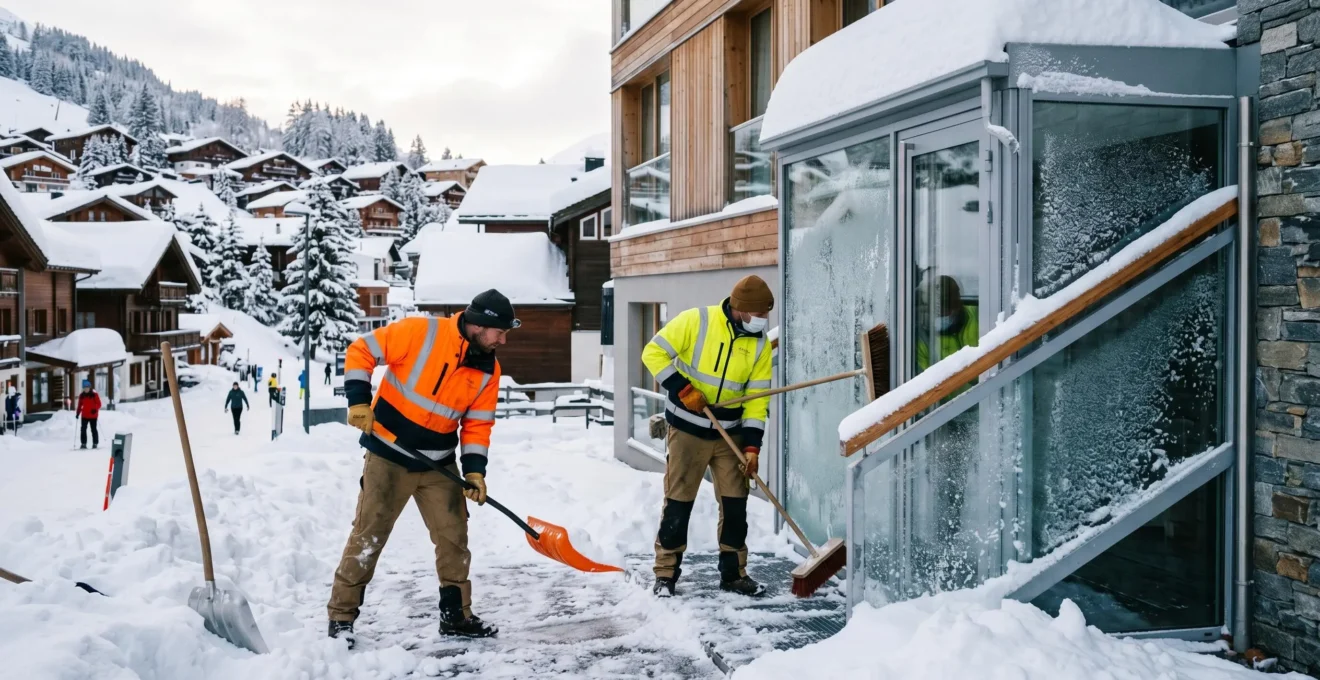
The categories to scrutinise before any projection can be trusted include syndic de copropriété fees (which tend to be higher in resort buildings due to year-round maintenance obligations and the seasonal intensity of usage), snow clearance and de-icing contracts for common areas, lift infrastructure levies where the residence has direct ski-in access, and the reserve fund contributions mandated for major renovation cycles. In an older resort building, a vote for façade renovation or elevator replacement can trigger an exceptional charge that an investor operating on a tight monthly cash flow has no mechanism to absorb without disrupting the repayment schedule.
The credit market context adds a further dimension to the charge analysis. According to data published by the Banque de France for October 2025, the outstanding stock of residential mortgage lending to French households stands at €1,059 billion, with the average rate on new mortgage lending at 3.52%. For an investor financing a Courchevel acquisition at or near that rate level, the interest charge in the early years of the loan is a significant component of monthly outgoings — which reinforces the importance of knowing, not estimating, what the annual copropriété charge line will add to the total cost structure.
Watch point: French syndic documents (procès-verbaux d’assemblée générale) from the past three years must be reviewed before purchase. They reveal voted works, upcoming reserve fund calls, and any litigation involving the copropriété — each of which directly affects the charge forecast and therefore the repayment model.
Management fees are a separate line that interacts with the yield calculation in a way that is often presented simplistically. A full-service seasonal rental management contract — handling reservations, key handover, cleaning, and concierge — commands a fee structure that reduces net rental receipts. The trade-off is real but rational for an owner based in Paris or London: the alternative (self-managing from a distance) introduces vacancy risk, rating deterioration on booking platforms, and administrative complexity that erodes yield more severely than a well-structured management contract. The net yield after management fees is the figure that should be modelled against mortgage service, not the gross.
Your action plan before signing
The theoretical case for paying off a mountain apartment in ten years through rental income is sound — but it is built on four operational decisions that must be made before the notarial deed, not after. Getting the sequence right is what separates investors who achieve the target from those who revise it upward to fifteen years two seasons in.
- Model net rental receipts (after management fees and platform costs) against your specific mortgage service at the current lending rate — not a generic yield percentage.
- Obtain a formal opinion from a specialist accountant on LMNP régime réel versus micro-BIC for your acquisition price and projected receipts before the first tax year closes.
- Review at minimum three years of syndic documents to establish the real annual charge trend and any exceptional works voted or anticipated.
- Confirm the meublé de tourisme classé application process and timeline with the local mairie — the classification is a prerequisite for the most favourable BIC treatment and should not be assumed to be automatic.
- Stress-test the repayment model against a scenario where one winter season generates 70% of projected receipts — weather disruption and booking platform volatility are real variables in any Alpine investment horizon.
These steps are not bureaucratic friction — they are the architecture of a credible financial plan. Investors who treat them as optional tend to discover the omission in year three or four, when a gap between projected and actual net cash flow forces a renegotiation of the repayment pace. Those who complete them before signing are positioned to act on the one factor that none of the above can replace: selecting the right property in the right location. That decision — altitude, proximity to ski infrastructure, building quality, micro-village positioning within the station — determines the ceiling on rental receipts and therefore the realism of the ten-year horizon. On that question, local expertise with genuine knowledge of which assets consistently outperform within the strategies that maximize your property’s appraised value is the variable that no spreadsheet model can substitute for.
Does rental income really cover mortgage repayments on a Courchevel apartment?
It depends on the ratio of acquisition price to seasonal rental receipts, and on how effectively the fiscal drag is managed through the LMNP régime réel. There is no universal figure — but the combination of premium nightly rates during peak ski weeks and the amortisation deductions available under BIC real accounting creates conditions where rental receipts can cover a significant share of annual debt service, particularly in the early years when mortgage interest is highest and therefore most deductible.
What happens to the LMNP status if I use the apartment personally during ski season?
Personal use weeks reduce the number of rentable nights, which directly affects annual rental receipts. Under the LMNP réel regime, charges and amortisation are deducted proportionally against the rental activity — so a reduction in rental weeks also reduces the absolute value of deductible expenses. The practical effect is a higher net taxable income per rented night. Investors who plan regular personal use should model this explicitly rather than assuming the fiscal position remains unchanged.
Is off-season rental income worth pursuing, or should the property sit empty?
The summer hiking and mountain biking season in Les Trois Vallées generates genuine demand — at lower nightly rates than winter peaks but with meaningful occupancy potential in July and August. Whether to activate that market depends on the management structure in place and whether the incremental revenue after fees and additional wear justifies the effort. For investors targeting accelerated repayment, any additional rental income that exceeds its associated costs contributes directly to reducing the outstanding capital — so the economics of off-season lettings deserve a serious calculation rather than a default assumption in either direction.