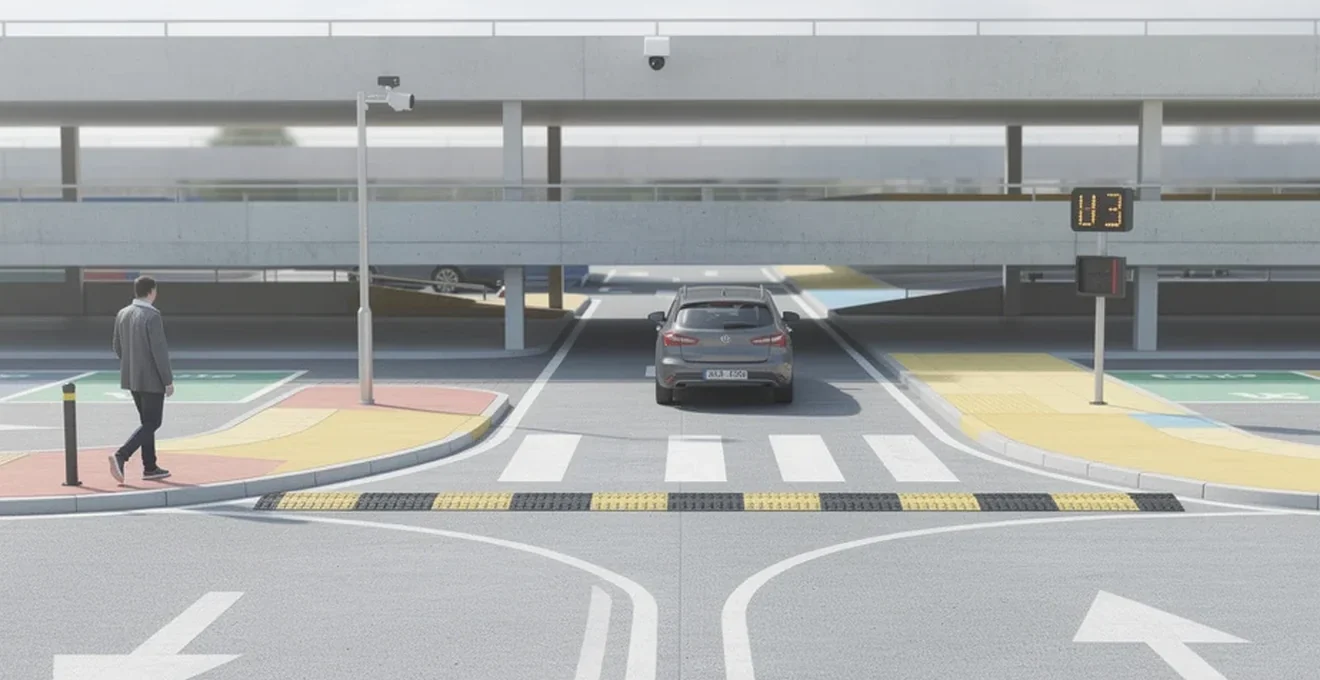
Vehicle speed is one of the most significant factors in car park safety. Unlike open roads, car parks bring vehicles and pedestrians into close, unpredictable contact – drivers reversing out of bays, shoppers weaving between cars, delivery vehicles manoeuvring near building entrances. Even at low speeds, this mix of movement creates real risk of collision and injury. Managing that risk means combining physical design, clear visual guidance, and increasingly, technology-driven monitoring.
This guide sets out the practical measures available to car park operators and site managers who want to reduce vehicle speeds and keep pedestrians safe – from speed bumps and chicanes to ANPR systems and layout planning. It also looks at how to measure whether these measures are actually working, and how to keep improving over time.
Why vehicle speed management matters in car park design
Car parks are rarely designed with speed as the first thing on a driver’s mind. Most users are focused on finding a space, getting to a till on time, or beating the rain to the entrance. This is precisely why speed management needs to be built into the design of the space rather than left to driver judgement alone.
Pedestrian-vehicle conflict points and collision risk
Every car park contains points where vehicles and pedestrians are likely to cross paths – entrances, aisle junctions, and the routes between parking bays and building doors. Even in low-speed environments, vehicles can cause serious injury, particularly where pedestrians are present. Reduced speeds give drivers more time to react to obstructions or pedestrians, and any resulting impact will cause less damage. Blind corners and reversing zones around loading bays or school drop-off areas carry a particularly high risk, and these locations deserve close attention when planning warning signs, mirrors, and physical calming measures.
Insurance claims data and liability exposure for car park operators
Poorly controlled speed in a car park doesn’t just create a safety issue – it creates a liability one. Repeated low-speed impacts from vehicles overshooting bays or clipping kerbs can damage buildings, payment machines, lighting columns, and EV chargers, generating ongoing repair costs. Where pedestrians are involved in a collision, operators can face significant exposure if it can be shown that reasonably foreseeable risks – such as a lack of speed control near a pedestrian crossing – were not addressed. A car park with a considered speed management strategy is easier to defend from a liability standpoint than one relying on signage alone.
British parking association (BPA) safety standards and compliance
Professional car park management in the UK is generally expected to follow recognised industry standards, including codes of practice set by bodies such as the British Parking Association. These standards support fair, transparent, and legally sound operation of a car park, covering everything from signage clarity to enforcement practices. Aligning speed management measures with recognised industry expectations helps operators demonstrate that they have taken reasonable steps to protect users, which matters both for day-to-day safety and for defending against complaints or claims.
Physical traffic calming measures for speed reduction
Signs tell drivers what to do, but physical measures make them do it. Visual cues and speed limit signage are useful, but drivers entering a car park from a faster road often misjudge their actual speed even after noting a posted limit. Physical traffic calming closes that gap.
Speed bumps, humps and speed cushions: specification and placement
Speed bumps work best on long, straight runs, outside entrances, near pedestrian crossings, and around schools, depots, and warehouses – anywhere drivers are likely to build up speed without a visual reason to slow down. Speed cushions offer an alternative where a full-width bump isn’t ideal: these are longer, smoother ramps that slow cars in a more controlled way while remaining narrow enough for large vehicles, such as delivery lorries, to pass over without excessive jolting. This makes cushions particularly suitable for car parks that need to accommodate both regular cars and larger vehicles on the same routes.
Chicanes and lane narrowing techniques
Narrowing a driving lane or introducing a slight offset in the route forces drivers to slow down and pay closer attention, since it removes the option of driving in a straight, unbroken line. This kind of physical narrowing works well in combination with other calming measures and can be particularly effective at the point where a car park’s main circulation route meets a pedestrian crossing point or building entrance.
Rumble strips and textured road surfacing
Textured surfacing gives drivers a physical and audible cue that they are approaching a zone requiring more care, reinforcing the message carried by signage and markings. It works alongside line marking paint and anti-slip marking products, which are also useful for designating pedestrian areas clearly underfoot.
Raised tables at pedestrian crossing points
Raising the road surface at a crossing point combines the visibility benefits of a marked crossing with the physical speed-reducing effect of a raised table, prompting drivers to slow down precisely where pedestrians are most likely to be crossing. This is especially valuable near building entrances, reception areas, and any route that pedestrians are expected to use regularly to move between parking bays and their destination.
Signage, road markings and visual cues for speed control
Good signage and markings reduce hesitation, confusion, and poor driving decisions, and remain one of the lower-cost ways to improve car park safety. However, sign placement matters as much as the sign itself: signs need to be positioned at the right height and location so they’re visible before a driver needs to act, and they should be reflective to remain effective in poor light or bad weather.
Regulatory speed limit signage under the traffic signs regulations and general directions (TSRGD)
Speed limit signs at car park entrances set driver expectations from the moment they arrive on site, and should be clearly visible and well maintained. As with all car park signage, warnings should be placed well before the relevant hazard, giving drivers enough time to adjust their speed rather than reacting at the last moment.
Painted speed limit roundels and directional arrows
Road markings help drivers understand the space without needing to stop and think, preventing the kind of chaotic “free-for-all” that leads to accidents. Speed limit markings are particularly useful at entrances, reinforcing the message on accompanying signage. Directional arrows support one-way systems and logical traffic flow, reducing the unpredictable manoeuvring that increases collision risk. These markings can be created using liquid paints or thermoplastics; thermoplastic markings are bonded to the surface with heat and are available as preformed symbols or rolls of tape, offering good durability for high-traffic areas.
Colour-coded zoning and bay demarcation strategies
Colour is an effective way to make specific zones instantly recognisable – for example, painting disabled bays blue or EV charging bays green. Clearly defined zones for loading, visitor parking, parent and child bays, and no-parking areas all help drivers self-regulate their behaviour and reduce unnecessary manoeuvring. Markings do fade with use and weather, so periodic refreshing is necessary; faded lines cause confusion and poor parking behaviour, and worn thermoplastic markings can even become slippery in wet conditions.
Technology-driven speed enforcement solutions
Physical and visual measures form the foundation of speed management, but technology now plays an increasing role in monitoring compliance and reinforcing safe behaviour without requiring constant staff presence.
ANPR camera systems for speed monitoring
Automatic number plate recognition (ANPR) systems allow operators to monitor vehicle movements accurately across a site. Beyond their well-established role in preventing unauthorised parking and enforcing time limits, ANPR systems support broader site oversight by reducing the need for manual patrols and improving the accuracy and transparency of monitoring. Car parks using ANPR must handle the personal data involved in line with UK data protection requirements, including having a lawful reason for collecting it, informing users clearly how it will be used, and storing it securely for no longer than necessary.
Vehicle-activated speed warning signs (VAS)
Signs that respond directly to a vehicle’s speed give drivers immediate, situation-specific feedback, which tends to prompt a more consistent reduction in speed than static signage alone. Positioning these near known conflict points, such as pedestrian crossings or blind corners, reinforces the message exactly where it matters most.
Radar-based detection and automated speed alerts
Convex mirrors are a simple, low-cost way to widen the field of vision at blind corners and reversing zones, helping both pedestrians and drivers spot each other in good time. Radar-based detection systems extend this principle further, offering automated alerts that flag vehicles travelling too quickly through particular zones, supporting warning signs already in place at higher-risk locations such as loading areas and school drop-off points.
Barrier and access control systems linked to speed compliance
Access control infrastructure, including barriers and bollards, does more than simply manage who can enter a site – it can also be used to physically slow traffic at entry and exit points, where speed is often hardest to control due to drivers carrying momentum from faster public roads. Bollards are also valuable for protecting vulnerable points such as building entrances, shopfronts, EV charging points, and trolley bays from vehicles that overshoot a bay or lose control at low speed. Cast-in bollards, embedded into concrete or tarmac, offer greater strength than surface-mounted versions, while retractable or removable bollards allow access to be restricted outside operating hours without blocking it during the day.
Layout optimisation and circulation planning
No amount of signage or physical calming can fully compensate for a poorly designed layout. Getting the circulation plan right from the outset reduces the number of situations where speed becomes a problem in the first place.
One-way traffic flow systems and aisle width ratios
Clear signage combined with directional markings can create specific routes and one-way flows, making traffic movement more predictable throughout the site. Predictable traffic flow reduces the erratic manoeuvring that often leads drivers to speed up unexpectedly or brake sharply. Wherever possible, parking areas should be designed so that only simple manoeuvres are needed to park and leave, and layouts should minimise the need for reversing – particularly for larger vehicles. Arranging parking bays at an angle against the flow of traffic is a recognised way of encouraging reverse-in parking, which reduces the number of vehicles reversing directly into a live traffic flow and improves visibility for departing drivers.
Sightline design at junctions and blind corners
Blind corners and junctions within a car park are prime locations for collisions, since drivers and pedestrians alike may have little warning of each other’s presence. Warning signs at these points alert both parties to take extra care, while convex mirrors help widen the field of vision where structural layout can’t be changed. Where possible, drivers leaving parked vehicles should not have to cross potentially dangerous traffic routes to reach their destination, and parking areas should be positioned as close as practical to where people actually need to go.
Segregated pedestrian walkways and zebra crossings
The safest car parks make pedestrian routes obvious, typically marking out walkways with bollards or barriers and creating zebra-style crossings supported by signage advising pedestrians to look both ways. Physical precautions such as bollards and barriers help prevent vehicles from crossing into walking areas, while keeping delivery routes separate from visitor parking supports both pedestrian safety and smoother overall traffic flow. Extra separation should be built in around loading bays, disabled bays, and parent/child spaces, where pedestrians are more likely to be moving with buggies, trolleys, or reduced mobility.
Measuring and sustaining speed compliance over time
Speed management isn’t a one-off installation – it needs ongoing review to remain effective, particularly as usage patterns, vehicle types, or site layout change over time.
Traffic surveys and speed data collection methodologies
Understanding how a car park is actually used is the starting point for effective speed management. A proper risk assessment should establish how many vehicles use the site, where they go, what drivers do once they arrive, and what types of vehicles are involved. Where parking is a persistent problem, a full survey of parking demand and availability may be worthwhile, potentially involving professional engineers to assess the site in detail.
Behavioural audits and driver compliance reporting
Regular checks should confirm that all car park safety features remain visible and in good working order – signage that isn’t damaged or dirty, markings that haven’t faded, and speed bumps or wheel stops that remain secure. Bent or missing bollards should be identified and repaired promptly. These audits give a practical, ongoing picture of whether speed control measures are still doing their job, or whether driver behaviour has begun to drift as familiarity with the site increases.
Continuous improvement through health and safety executive (HSE) guidelines
A sound risk assessment framework should keep returning to a core set of questions: how parking needs to be controlled, how pedestrians will be segregated from traffic, how the need for manoeuvring and reversing can be minimised, and how safe parking will be enforced. Controlled parking areas are particularly important wherever uncontrolled parking could narrow routes, block sightlines, or force pedestrians onto vehicle routes. Parking areas themselves should be firm, level, well drained, not slippery, and well lit where possible, and should be clearly signposted so that drivers understand from the outset where they may park and how those areas are identified. Reviewing these factors on an ongoing basis – rather than treating car park safety as a fixed, one-time installation – is what allows speed compliance to be sustained as the site and its users change.